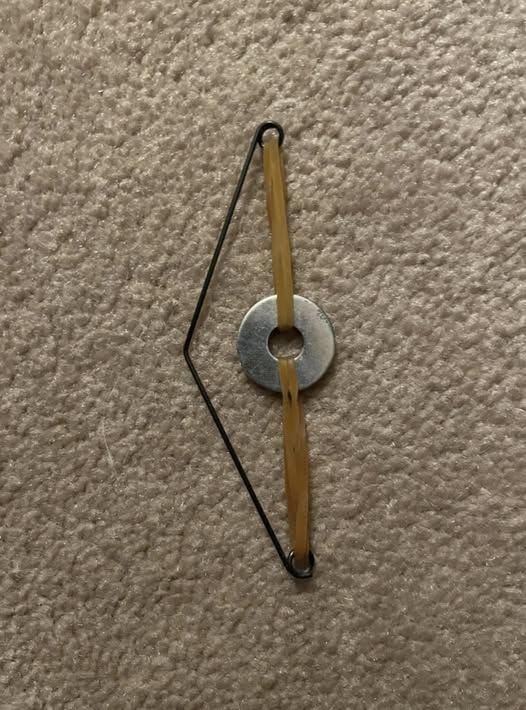
Tucked away in the back of a drawer or buried beneath old scarves, you may discover a strange little contraption made from bent wire, a rubber band, and a metal washer. At first glance, it looks like a broken clip, an unfinished craft project, or a piece that fell off an old household object.
Its real purpose is far more entertaining. This curious device is commonly known as a rattlesnake eggs envelope prank, a classic novelty designed to surprise someone with an unexpected buzzing or rattling sound when an envelope is opened.
Despite its name, it has nothing to do with real snakes or snake eggs. It is simply a small mechanical noisemaker that uses a twisted rubber band to create a sudden vibration.
What Is the Rattlesnake Eggs Prank?
The rattlesnake eggs prank is a traditional practical joke usually hidden inside an envelope, greeting card, small book, or folded piece of paper. The device typically consists of a wire frame, a rubber band, and a washer, button, or similar object positioned in the center.
Before the envelope is closed, the washer is rotated repeatedly to twist the rubber band. When the recipient opens the envelope, the washer begins spinning rapidly as the rubber band unwinds.
The spinning washer strikes or vibrates against the surrounding paper, producing a loud buzzing or rattling noise. Because the sound begins suddenly and comes from something the recipient cannot immediately see, it can resemble the warning rattle associated with a snake.
The device does not normally leap out of the envelope like a spring-loaded toy. Its main effect comes from the unexpected noise and vibration.
Why Was It Called “Rattlesnake Eggs”?
The prank was often presented with a humorous note claiming that the envelope contained “genuine rattlesnake eggs.” A curious recipient would carefully open the envelope to investigate, only to hear a sudden rattling sound.
For a brief moment, the recipient might believe that something alive was moving inside. The name made the trick more convincing because many people had never seen real snake eggs and did not know what to expect.
In reality, rattlesnakes do not lay eggs in the ordinary sense. They are ovoviviparous, meaning their young develop in eggs that remain inside the mother’s body until they hatch. The mother then gives birth to live young.
The phrase “rattlesnake eggs” was therefore part of the joke rather than an accurate description of rattlesnake reproduction.
How the Device Works
The mechanism is simple but surprisingly effective. It relies on stored elastic energy.
- A rubber band is stretched across a small wire frame.
- A washer, button, or lightweight metal disc is attached at the center.
- The washer is rotated several times, twisting the rubber band.
- The device is placed inside a folded card or envelope while the washer remains wound.
- When the envelope is opened or moved, the washer is released.
- The rubber band unwinds rapidly, causing the washer to spin and vibrate against the paper.
The envelope acts as a sound chamber, amplifying the vibration and making the small device sound much louder than expected.
Is It Really a Vintage Object?
Variations of rubber-band noisemakers and envelope pranks have circulated for generations. They became familiar novelty items in joke shops, magic stores, party-supply shops, and mail-order catalogs during the twentieth century.
Some were commercially manufactured, while others were homemade using wire, rubber bands, buttons, washers, or small pieces of cardboard. Their simplicity made them easy to copy and pass from one generation to another.
Because many were homemade, it can be difficult to assign a precise date or manufacturer to an individual example. The materials may offer clues: an aged rubber band, oxidized wire, handmade bends, or an old-style metal washer may suggest that the object has been stored for many years.
However, its appearance alone cannot confirm that it is a valuable antique. Most examples were inexpensive novelty toys rather than rare collectibles.
Why People Often Mistake It for Something Else
When removed from its envelope or card, the device loses the context that explains its purpose. A person finding one loose in a drawer may reasonably mistake it for:
- A broken fastening clip
- A piece of jewelry hardware
- A sewing or knitting accessory
- A homemade fishing component
- A part from an old toy
- A school science project
- A handmade trap or alarm
- A forgotten craft experiment
The combination of wire, rubber, and metal looks functional, but its function is not obvious until the washer is wound and the device is placed inside folded paper.
The most surprising part is not how old the prank may be, but how three ordinary materials create such a convincing burst of sound.
How to Recognize an Authentic Rattlesnake Eggs Noisemaker
Most versions share a few recognizable features:
- A small rectangular, oval, or irregular wire frame
- A rubber band stretched between opposite sides of the frame
- A metal washer, button, bead, or disc attached to the rubber band
- Enough space for the center piece to rotate freely
- A size small enough to fit inside an envelope or greeting card
Some examples use a paper clip or thin wooden frame instead of shaped wire. Commercial versions may have printed instructions, packaging, or a card describing the contents as rattlesnake eggs.
How to Test an Old One Safely
If you find an old example, examine it before attempting to wind it. Rubber deteriorates with age and may become brittle, sticky, cracked, or stretched beyond use. Old wire can also develop sharp points or rust.
To inspect it safely:
- Place the object on a table in good lighting.
- Check the wire for sharp, broken, or rusty ends.
- Look for cracks or deterioration in the rubber band.
- Do not stretch a rubber band that appears brittle.
- Keep the device away from your eyes and face.
- If it remains intact, rotate the washer only a few times.
- Place it inside a folded piece of sturdy paper before releasing it.
If the rubber band is badly degraded, replacing it is safer than attempting to operate the original. If you believe the object may have sentimental or collectible value, preserve the original parts and avoid unnecessary handling.
How to Make a Simple Version
A homemade version can be created with a few inexpensive materials. Adult supervision is recommended whenever wire cutters or shaped wire are involved.
Materials
- A sturdy paper clip or a short piece of smooth craft wire
- A strong rubber band
- A small metal washer or large flat button
- Pliers for shaping the wire
- A business-size envelope or folded greeting card
A paper clip is generally easier and safer to work with than a cut coat hanger. Coat-hanger wire can be difficult to bend and may leave sharp ends.
Instructions
- Straighten and reshape the paper clip or craft wire into a small rectangular or oval frame.
- Make sure the wire ends are bent inward so that no sharp points remain exposed.
- Loop the rubber band securely around opposite ends of the frame.
- Place the washer or button at the center of the rubber band.
- Check that the washer can rotate without immediately striking the wire frame.
- Turn the washer approximately 10 to 20 times to twist the rubber band.
- Hold the washer in place and carefully slide the device into an envelope.
- Close the envelope without crushing the mechanism.
- When the envelope is opened or handled, the washer should spin and create a rattling sound.
Begin with only a few turns. Excessive winding can break the rubber band, bend the frame, or cause the washer to move more forcefully than intended.