Some people use a diluted vinegar solution as an additional washing step. Vinegar may help loosen certain surface residues and dirt, although it should not be considered a method for completely eliminating pesticides.
A commonly used homemade solution is approximately one part white vinegar to nine parts water.
Place firm fruits or vegetables in the diluted solution for several minutes, then rinse them thoroughly under fresh running water before eating or storing them.
Delicate fruits such as raspberries, strawberries, blackberries, and other soft berries should not be soaked for long periods. Their porous and fragile surfaces can absorb liquid and become soft or damaged.
If you use vinegar, always rinse the produce afterward to remove any remaining taste or smell.
Salt Water as Another Option
Salt water has also been studied as a way of reducing certain pesticide residues located on the surface of produce.
Some experiments comparing plain water with salt-water or vinegar solutions have found that salt water may remove more of certain pesticide residues under specific conditions. However, results vary according to the pesticide, the fruit or vegetable being tested, and the washing time.
A simple salt-water rinse can be prepared by dissolving a small amount of salt in clean water. After soaking or washing the produce, rinse it thoroughly with fresh water.
This method should be viewed as an optional washing technique rather than a guarantee that all pesticide residues will disappear.
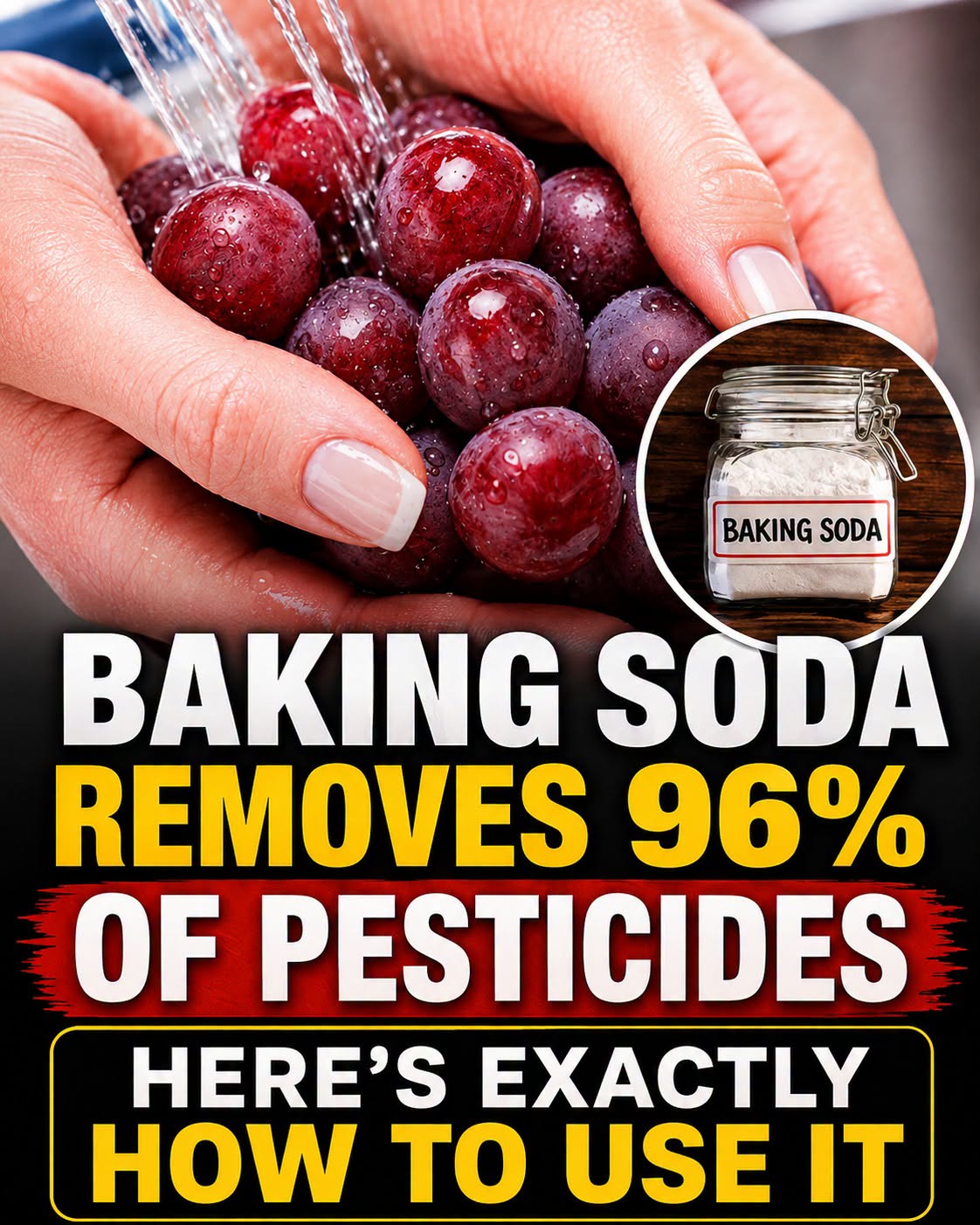
Baking soda has also attracted attention because research suggests it may remove some surface pesticide residues more effectively than plain water under certain conditions.
Baking Soda and Water
Baking soda, also known as sodium bicarbonate, has been studied as another possible method for reducing pesticide residues on produce.
In one laboratory study involving apples, researchers compared several washing methods and found that a baking-soda solution was effective at reducing certain pesticide residues present on the surface of the fruit.
The researchers also found an important limitation: pesticide compounds that had already penetrated deeper into the apple peel were much more difficult to remove.
This means that even an effective surface wash cannot necessarily remove pesticide residues that have moved beneath the outer layer of a fruit or vegetable.